
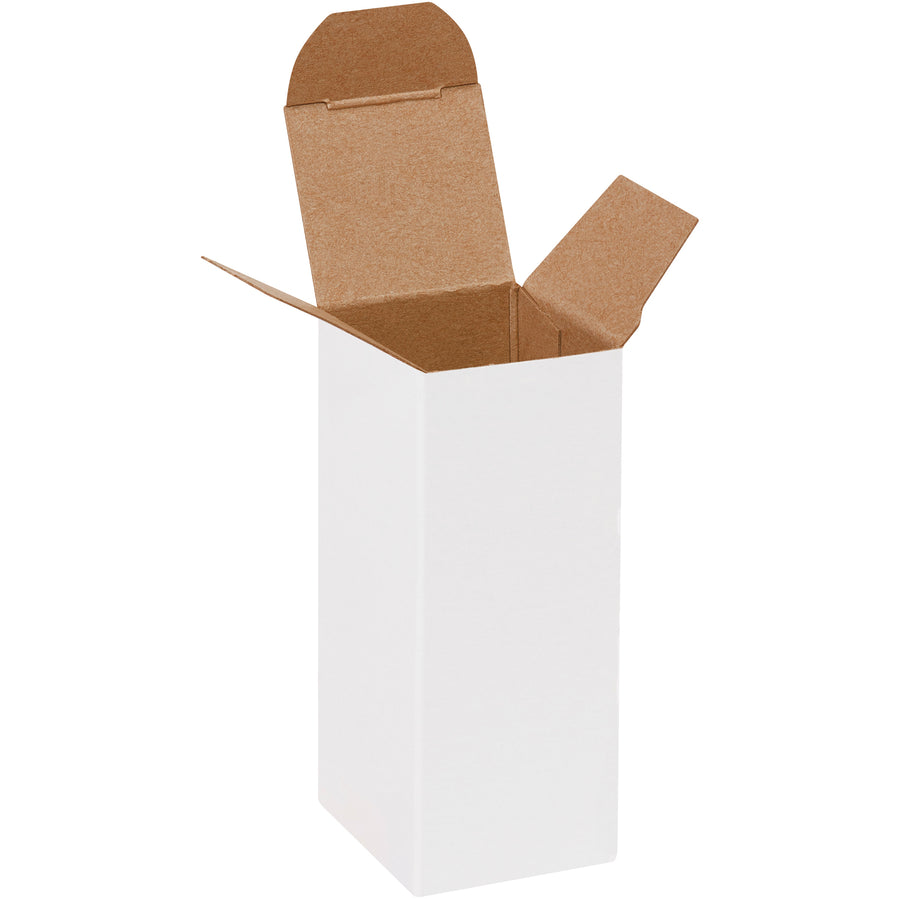
1.5x1.5x4 24pt White Fibreboard Reverse Tuck Folding Cartons 1000/Case
$160.21
/ case of 1000$0.16 per carton
Request bulk pricing
| Quantity (case) | Item-subtotal discount |
|---|---|
| 1–2 | Base item price |
| 3–5 | 3% off qualifying item subtotal |
| 6+ | 5% off qualifying item subtotal |
In stock · ships within 1 business day from the nearest of 5 US warehouses (IL, PA, TX, GA, CA) · 1–5 business days in transit · freight calculated at checkout · free ground shipping on orders over $99 (parcel rates up to $29.95) and over $500 (up to $120)
30-day returns on stock items · Return policy
Inside dimensions
1 1/2" × 1 1/2" × 4"
Board / material
.024 Point Die-Cut Fibreboard
Color
White
Freight class
Class 70

Specifications
| Inside dimensions | 1 1/2" × 1 1/2" × 4" (L × W × H) |
|---|---|
| Board / material | .024 Point Die-Cut Fibreboard |
| Color | White |
| Sold as | Case of 1000 |
| Physical units per order increment | 1 |
| Case weight | 26.06 lb |
| Outer carton (shipping) | 20.5 × 18.5 × 7.0 in |
| LTL freight class | Class 70 |
| GTIN | 841436050500 |
| SKU | RTD1W |
About this item
SKU RTD1W — 1 1/2" × 1 1/2" × 4", .024 Point Die-Cut Fibreboard, White. Sold as a case of 1000, shipped from US warehouses.
Premium 1.5 " x 1.5 " x 4 " white reverse tuck folding cartons made from durable 24-point die-cut fibreboard. Featuring pye-lock tucks for positive locking and shipped flat to maximize storage and reduce shipping costs. Case of 1000 units meets or exceeds federal specification PPP-B-566.
Nearby exact-spec options
Use these when the size, material, pack quantity, or workflow is close but not identical.
 nearby size option
2.5x1.75x4 Kraft Reverse Tuck Folding Cartons 500/Case
$77.62
nearby size option
2.5x1.75x4 Kraft Reverse Tuck Folding Cartons 500/Case
$77.62 nearby size option
1.5x1.5x2.25 24pt White Fibreboard Reverse Tuck Folding Cartons 1000/Case
$131.90
nearby size option
1.5x1.5x2.25 24pt White Fibreboard Reverse Tuck Folding Cartons 1000/Case
$131.90 nearby size option
3x2.5x4 Kraft Reverse Tuck Folding Cartons 500/Case
$86.59
nearby size option
3x2.5x4 Kraft Reverse Tuck Folding Cartons 500/Case
$86.59 nearby size option
3 x 1 5/16 x 3 in Kraft Reverse Tuck Folding Cartons 1000/Case
$149.77
nearby size option
3 x 1 5/16 x 3 in Kraft Reverse Tuck Folding Cartons 1000/Case
$149.77

Common questions
Do these cartons require glue or tape to seal?
No. The integrated pye-lock tuck design provides a positive, secure closure without additional adhesives or tape, saving time during packing operations.
Are these cartons compliant with shipping regulations?
Yes. These cartons meet or exceed federal specification PPP-B-566, ensuring full compliance with USPS, UPS, and FedEx shipping standards.
What products work best in this size?
The 1.5" x 1.5" x 4" dimensions are ideal for small, lightweight items including cosmetics, vitamins, jewelry, electronics, tea, spices, and sample products.
How much storage space do flat cartons save?
Flat-folded cartons reduce storage footprint by up to 90% compared to pre-assembled boxes, lowering warehouse costs and enabling faster inventory turnover.
Order support
Questions on specs or freight?
Send the SKU, quantity, and delivery ZIP and we will confirm specs, availability, and freight before you order.